
Parents frequently search for affordable children’s clothing, but affordability and value are not exactly the same thing.
An item is affordable when its purchase price fits the family’s budget. An item offers good value when its quality, usefulness and lifespan justify that price.
A very inexpensive garment can become costly if it fades, shrinks or tears after a few washes. A higher-priced item can also be poor value if it is uncomfortable or only suitable for one highly specific occasion.
Understanding value helps families spend more intentionally without giving up style.
Look Beyond the Price Tag
Price is easy to compare because it is represented by one number. Quality and usefulness require more thought.
When deciding whether an outfit offers good value, consider five factors:
- How often will the child wear it?
- How well is it made?
- How easily can it be washed?
- Can it be styled in several ways?
- Is the child likely to feel comfortable in it?
The lowest-priced option may still be the right choice for a short-term need. For example, a simple themed shirt for a one-day school event does not need the same construction as a dress intended for regular use.
The goal is not to buy the most expensive clothing. It is to match the level of investment to the garment’s purpose.
Understand Cost Per Wear
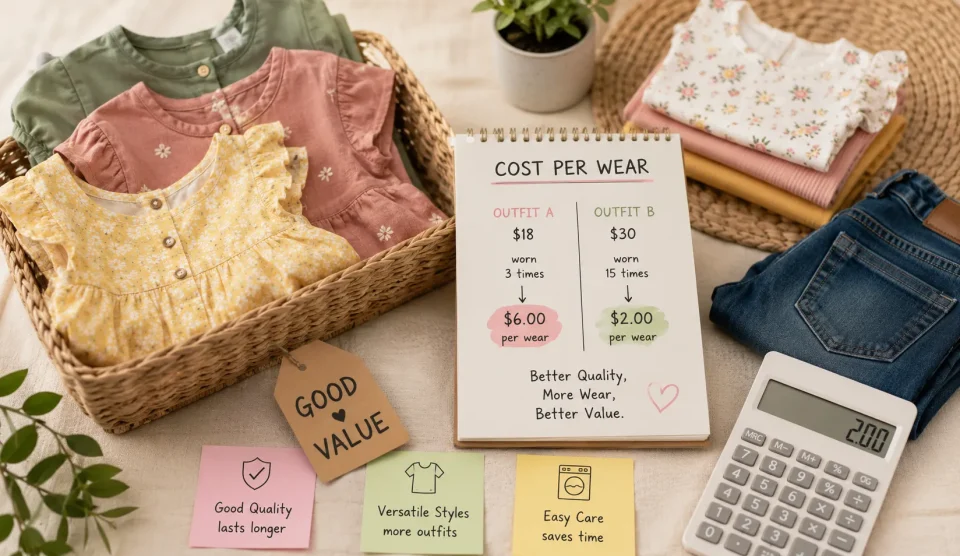
Cost per wear is a simple way to think about value:
Cost of the garment ÷ Number of times worn = Cost per wear
Suppose Outfit A costs $15 and is worn three times. Its cost per wear is $5.
Outfit B costs $30 and is worn fifteen times. Its cost per wear is $2.
Outfit B costs more at checkout but provides better value over time.
This is particularly relevant for everyday dresses, shirts, pants and versatile sets. These garments can become some of the most valuable items in a child’s wardrobe because they are used repeatedly.
For special-occasion outfits, cost per wear may naturally be higher. Parents can improve value by choosing designs that work for several types of events instead of only one.
Durability Is More Than Thick Fabric
A thick garment is not automatically durable, and a lightweight garment is not automatically fragile.
Durability comes from the combination of fabric, stitching, construction and care.
Inspect high-stress areas such as:
- Underarm seams
- Shoulder seams
- Waistbands
- Buttonholes
- Zippers
- Knees and seat areas
- Points where ruffles or decorative panels are attached
Fabric should be suitable for the activity. A delicate, flowing material may be completely appropriate for a celebration dress, even though it is not intended for playground use.
Good value means the product performs well in the situation for which it was designed.
Versatility Increases Value
A versatile garment can be styled for several settings.
A printed children’s dress may be worn alone during summer, paired with a cardigan in cooler weather or dressed up with a coordinated hair accessory for a family event.
A boys’ shirt can work with shorts for a casual outing, jeans for everyday wear or dress pants for a more formal occasion.
Traditional-inspired sets can also provide flexibility. The pieces may be worn together for a complete look or styled separately with simpler items already in the wardrobe.
Before buying an outfit, imagine at least three ways or occasions in which it could be used. When the answer comes easily, the piece is more likely to earn its place in the wardrobe.
Comfort Protects the Investment
An outfit has little value if a child refuses to wear it.
Parents may understandably focus on the visual design, but children experience the garment through its fit and feel. Scratchy seams, heavy embellishments, restrictive sleeves or uncomfortable waistbands can turn a beautiful outfit into an unused one.
Look for:
- Soft contact points around the neck and arms
- Enough room for sitting and movement
- Secure but comfortable elastic
- Linings that do not feel rough
- Decorations that do not press against the skin
- Fabrics suited to the temperature
A fashionable garment becomes valuable when the child can actually enjoy wearing it.
Care Requirements Affect the Real Cost
The purchase price is not the only expense connected to clothing.
A garment that requires frequent professional cleaning may be reasonable for a rare formal event but impractical for everyday use. Clothing that must be hand-washed may also require more time than a busy household can consistently provide.
Check the care label before purchasing. The best everyday items generally fit into the family’s normal laundry routine.
Proper care also improves value. Washing in excessively hot water, using harsh products or applying high dryer heat can damage clothing before the fabric has reached its natural lifespan.
Avoid Buying Only for the Lowest Price
Constantly choosing the cheapest available option can create a cycle of repeat purchasing.
This does not mean families should ignore discounts or inexpensive products. It means price should be considered together with quality.
A low price represents good value when:
- The garment is suitable for its intended use
- Construction is reliable
- The fabric feels appropriate
- The child will wear it
- Care is manageable
- The fit is correct
A discount is not a saving when the product remains unworn.
Avoid Overbuying for Future Growth
Parents sometimes purchase many items in larger sizes because the price is attractive. This can be useful for basic clothing, but it also carries risks.
The child may grow differently than expected. Seasons may not align with the size. Preferences can change, and an item that seemed appealing a year earlier may no longer suit the child.
A more balanced approach is to maintain a functional current wardrobe and purchase future sizes selectively.
This reduces clutter and leaves room to respond to actual needs.
Think in Terms of a Wardrobe System
Individual pieces provide more value when they work together.
Choose a practical color base for pants, shorts, sweaters and layers. Then use prints and statement designs to add personality. This does not require a plain or minimalist wardrobe. It simply means considering coordination before purchasing.
For example, one neutral cardigan may work with three dresses. One pair of dark trousers may match several shirts. A festive top may be combined with an existing bottom rather than requiring an entirely new outfit.
This approach gives children variety while helping parents control total spending.
Quality Can Support Reuse
Well-maintained clothing may remain useful after the first child outgrows it.
Depending on its condition, a garment can be:
- Passed to a younger sibling
- Shared with a relative or friend
- Donated
- Resold
- Kept as a meaningful item
Reuse is easier when seams remain secure, fabric retains its shape and the design is not limited to an extremely short-lived trend.
Parents do not need every garment to last for years. However, better construction creates more options after the original use ends.
Value Is Personal
Every family has different priorities. Some focus on easy maintenance, while others need special designs, modest silhouettes, breathable materials or clothing suitable for cultural celebrations.
There is no universal price that defines good value.
At Bloom & Thread, our approach is based on balance. We look for fashionable clothing with good fabric, thoughtful construction and prices that remain accessible to families seeking something special without unnecessary luxury markups.
Good value is not about paying as little as possible. It is about receiving a product that performs as expected, suits the child and feels worthwhile each time it is worn.
When parents consider price, comfort, durability, versatility and care together, they can build a better wardrobe with fewer disappointing purchases.