
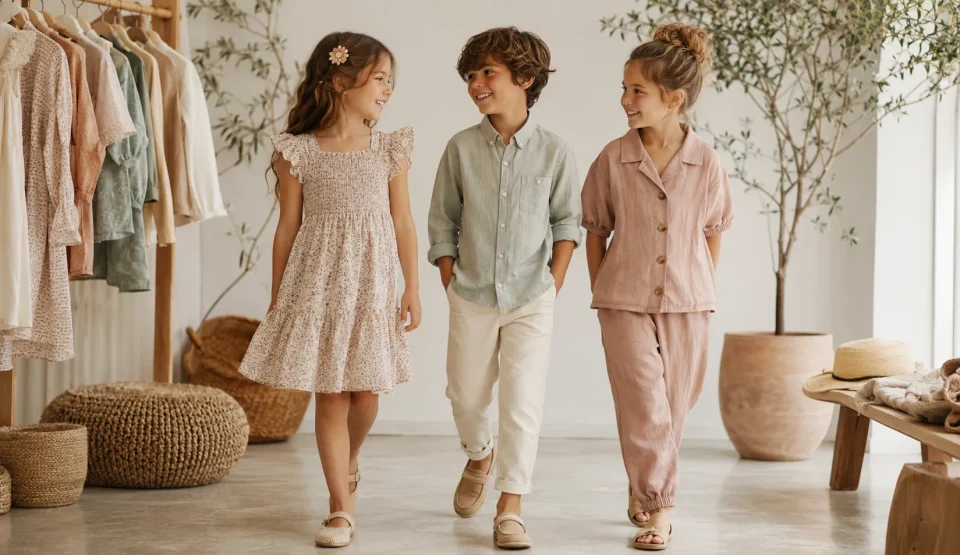
The children’s clothing industry is changing in 2026—but not simply because new colors or prints have become fashionable.
Parents are reconsidering how much clothing they buy, what quality they expect and how easily garments can fit into everyday family life. At the same time, children are becoming more involved in choosing what they wear, while online shopping, social media and resale platforms continue to influence purchasing decisions.
The result is a kidswear market that values style, but increasingly expects style to be supported by comfort, versatility and sensible pricing.
Industry estimates indicate that the global children’s clothing market is continuing to grow in 2026, supported by frequent size replacement, online retail and increasing interest in branded and distinctive childrenswear.
Here are some of the most important trends shaping children’s clothing in 2026.
1. Fashionable Clothing Must Also Be Practical
One of the clearest changes in 2026 is the movement away from clothing that looks attractive in photographs but is difficult for children to wear.
Parents still want beautiful dresses, smart shirts and distinctive coordinated outfits. However, they are paying closer attention to movement, softness, fastening systems and ease of care.
Fashionable children’s clothing increasingly includes practical elements such as:
- Elastic or adjustable waistbands
- Relaxed silhouettes
- Softer linings
- Lightweight layers
- Rollable sleeves
- Easy buttons and zippers
- Fabrics that can be washed at home
This reflects a broader understanding that good children’s fashion should work during real family activities—not only during a short photo session.
A dress may have ruffles, embroidery or an expressive print while still allowing a child to run and sit comfortably. A smart shirt can look polished without feeling stiff or restrictive.
For brands, practical design is becoming part of the fashion message rather than something separate from it.
2. Parents Are Looking for Better Value
Affordability remains a major concern in 2026. Families are becoming more cautious about discretionary spending and are comparing price with durability, versatility and expected use.
This does not always mean buying the cheapest available clothing. Instead, many parents are asking whether a garment offers good value over its useful life.
A slightly higher-priced dress may represent better value when it can be worn for family gatherings, vacations and birthday parties. A well-made shirt may work with shorts, jeans and more formal pants.
Retailers are responding by emphasizing accessible prices alongside improved materials, fit and durability. Recent value-focused retail launches have specifically promoted the idea that affordable fashion should not require families to accept poor quality.
For smaller children’s brands, this creates an important opportunity. They may not be able to compete with major retailers on the lowest possible price, but they can offer a better balance of quality, individuality and affordability.
3. Nostalgic and Vintage-Inspired Styles Are Returning
Children’s fashion in 2026 is showing a strong interest in the past.
Smocked dresses, gingham, Peter Pan collars, traditional knitwear, embroidered details and coordinated sibling outfits are being presented in updated forms. Current trend reporting also points to renewed interest in retro childhood aesthetics and vintage-inspired children’s clothing.
The attraction is partly visual. Traditional details can make a garment feel timeless and meaningful.
There is also an emotional element. Parents may be drawn to clothing that reminds them of their own childhood, family photographs or garments passed between generations.
Modern nostalgic clothing does not need to look old-fashioned. Brands are updating classic shapes with lighter fabrics, fresh colors, simpler styling and more comfortable construction.
For Bloom & Thread, this trend fits naturally with printed dresses, classic shirts and culturally influenced outfits that feel distinctive without becoming difficult to wear.
4. Coordinated Sets Are Becoming More Versatile
Two-piece and three-piece sets continue to gain attention because they provide parents with an easy, complete outfit.
In 2026, however, the strongest sets are not designed to be worn in only one way.
A printed top may be paired with its matching pants for a complete look, then worn separately with jeans. A coordinated bottom can be styled with a plain T-shirt. An additional scarf, overshirt or layer may create another variation.
This separates a useful coordinated set from an outfit that remains in the wardrobe after one occasion.
Parents increasingly appreciate clothing that reduces the effort of creating an outfit while still giving them several styling possibilities.
Sets also work well for online shopping because customers can immediately understand the intended appearance. Retailers should clearly explain which pieces are included and show both the complete outfit and possible separate combinations.
5. Cultural and Global Fashion Influences Are Expanding
The American children’s clothing market is becoming more open to styles influenced by different cultures.
South Asian silhouettes, embroidered tunics, printed sets, flowing dresses and modest shapes are increasingly visible beyond traditional cultural events. These designs can appeal to diaspora families while also attracting customers who simply want something different from standard mass-market clothing.
The opportunity is not limited to selling traditional clothing exactly as it has always been worn. Fusion styling allows cultural influences to appear in modern, accessible forms.
A detailed tunic can be worn with jeans. A printed two-piece outfit may work for a celebration or family dinner. A modest flowing dress can appeal to parents from several cultural backgrounds.
Successful brands need to explain these products clearly. Customers should understand the fabric, fit, pieces included and possible occasions for wearing the outfit.
Cultural variety becomes commercially stronger when it is supported by useful information rather than treated only as decoration.
6. Gender-Neutral Color and Styling Options Continue to Grow
Gender-neutral kidswear remains relevant in 2026, particularly in casual clothing and wardrobe basics.
This does not mean that traditionally feminine or masculine styles are disappearing. Floral dresses, decorative details and classic boys’ shirts remain important parts of the market.
The change is that families now have a wider range of options.
Colors such as sage green, rust, cream, mustard, denim blue and soft brown are being used across categories. Relaxed shirts, knitwear, overalls, jackets and simple coordinated sets can also be styled for different children.
Gender-neutral clothing may be especially useful for families planning to pass garments between siblings. It can also allow children to choose colors and designs according to individual preference rather than strict retail categories.
7. Sustainability Is Becoming More Practical
Sustainability has been discussed in fashion for years, but in 2026 the conversation is becoming more connected to everyday value.
Parents may not always choose a garment simply because it carries a sustainability label. However, many respond positively to clothing that lasts longer, can be passed down, uses better materials or avoids unnecessary packaging.
The sustainable fashion sector is projected to continue growing as consumers and businesses place more attention on materials, traceability and production practices.
For children’s brands, meaningful sustainability can include:
- Producing smaller, better-planned collections
- Choosing durable fabrics
- Avoiding excessive packaging
- Giving clear care instructions
- Designing clothing that can be worn repeatedly
- Creating garments that retain value for reuse
Parents are increasingly skeptical of vague environmental claims. Brands should communicate specific actions instead of relying on broad terms such as “green” or “eco-friendly.”
8. Secondhand and Resale Are Influencing New Clothing
Children often outgrow garments before the fabric is fully worn out. This makes kidswear especially suitable for resale and reuse.
In 2026, more parents are exploring secondhand marketplaces, curated vintage shops and clothing exchanges for both financial and environmental reasons. Recent reporting highlights growing demand for distinctive pre-owned children’s clothing, including vintage and limited pieces that offer more personality than standard retail products.
This trend also affects how parents judge new clothing.
A well-constructed garment may be easier to pass down, donate or resell. Clothing that maintains its color and shape has greater long-term value than a cheaper garment that quickly becomes unusable.
New brands can respond by focusing on construction quality and timeless design rather than treating resale as a threat.
9. Online Presentation Is Part of the Product
Because many parents discover and purchase children’s clothing online, product presentation has become essential.
Customers expect more than one attractive front-facing image. They increasingly need:
- Front and back views
- Fabric close-ups
- Accurate colors
- Product measurements
- Size guidance
- Information about the model’s size
- Details about lining and stretch
- Videos showing movement
- Clear return and exchange information
Digitalization, artificial intelligence and online personalization are playing a larger role in how children’s apparel is marketed and sold in 2026.
However, technology must increase clarity rather than create unrealistic expectations. Images should represent the garment accurately. Descriptions should explain what the customer will receive.
For an emerging brand, honest digital presentation is one of the strongest ways to establish credibility.
What These Trends Mean for Parents
The most important trend in 2026 is not one particular color, fabric or silhouette.
It is the expectation that children’s clothing should achieve several things at once.
Parents want clothes that are attractive but wearable, affordable but dependable, distinctive but versatile. They want enough variety to express personality without filling the wardrobe with garments that serve only one purpose.
At Bloom & Thread, these expectations closely match our core values. We believe good kidswear should combine fashionable design, reliable quality and a price that feels reasonable to families.
Trends will continue to change. The strongest children’s clothing, however, will remain grounded in the same principles: thoughtful materials, age-appropriate design, practical comfort and genuine value.